Quality of the builtin camera
has become a key selling point for smartphones these days. Samsung Galaxy K Zoom
has gone to such extremes that they put a zoom lens on the phone blurring the
lines of a standalone cam and camera phone. There are many who doesn’t want to
buy the HTC one only because it has a 4mp cam. There are even people who bought
the Nokia pureview lineup just for the camera. Today we are going to discuss an
old camera tech that could sort out the low light photography problem current phones face without adding any
expensive image stabilization or even compromises on resolution.

Before explaining the
tech itself, first let’s learn how an image sensor captures a picture. Image sensor
is a matrix of photodiodes which can just measure the intensity of light
falling on it. Which means it can only generate a black and white picture. To get
a colour image, we die the individual photo diodes with a primary colour. There
are several layouts in which the dies are arranged. The most common is Bayer pattern.
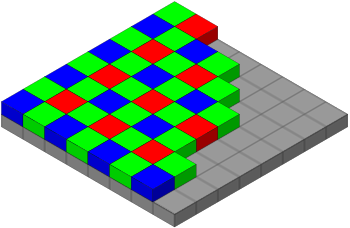 Here a red coloured
photo diode measures the intensity of red light and the green measures green
and blue does blue. The output from all 4 pixels is used to fix the colour of
one pixel in the final picture. This process is called demosaicing. Two green
colour pixels are used because human eyes
are more sensitive to the colour green. The problem with this pattern is, a
primary coloured die allows the passage of the light of its own colour and absorbs
the other two primary colours .
Here a red coloured
photo diode measures the intensity of red light and the green measures green
and blue does blue. The output from all 4 pixels is used to fix the colour of
one pixel in the final picture. This process is called demosaicing. Two green
colour pixels are used because human eyes
are more sensitive to the colour green. The problem with this pattern is, a
primary coloured die allows the passage of the light of its own colour and absorbs
the other two primary colours .
Let us assume that the
incident colour has equal amounts of red, blue and green. Red die allows just
1/3rd of the light to pass through it. Other portion is just wasted.
2/3rd loss is a big number because the size of the individual photo
diode is very small and every bit of light is important. (HTC chose 4mp
resolution to increase the size of individual pixels without changing the
overall size of the sensor.)
In the initial stages
of digital photography, there was another pattern, it used cyan, yellow, green and magenta giving a CYGM pattern.The benefit of the layout is that the dies are
secondary colours, they block only one primary colour, means they allow 2/3rd of the incident light
energy to pass through to the sensor. Only 1/3rd of the light is
absorbed. The increased sensitivity would allow even better low light photos
without that much of physical change. If price is not barrier, we can further
improve the pattern by adding an image
stabilisation and adding another white pixel like in the Motorola X ClearPixel.

The concept is pretty simple, yet the reason the technology was forgotten is because of the way things work in an industry. Almost everyone used the bayer pattern and hence big money and research was spent on optimising demosaicing and colour correction algorithms for that particullar pattern. No companies wanted to use a technology that was not actively developed. This is very similar to the app dilemma new mobile OS’ face. (people wont buy a phone without apps, app developers wont make apps on a platform that doesn’t have enough users.)
Now with the recent
advancements in image processing chips and more advanced algorithms, I think we
can give a second chance to this long forgotten design. I wish I could see a
pureview phone soon with CYGM pattern. Hope you enjoyed reading. Share your thoughts at
the comment section below.
You can share this article with the buttons placed at the bottom left
You can share this article with the buttons placed at the bottom left
CYGM gives better luminance,but at the expence of colour accuracy...CCDs are better, i believe...
ReplyDeleteEven bayer pattern sensors have color accuracy issues in the output from sensor. It is the image processing unit that sorts out the colour problem. With enough work put into the algorithms, the colour accuracy problem can be sorted out.
DeleteThis comment has been removed by the author.
ReplyDelete